



 Polski
 English
 Italiano
 Español
 Čeština
 Српски
 Deutsch
 Ελληνικά
 Slovenský




-
€
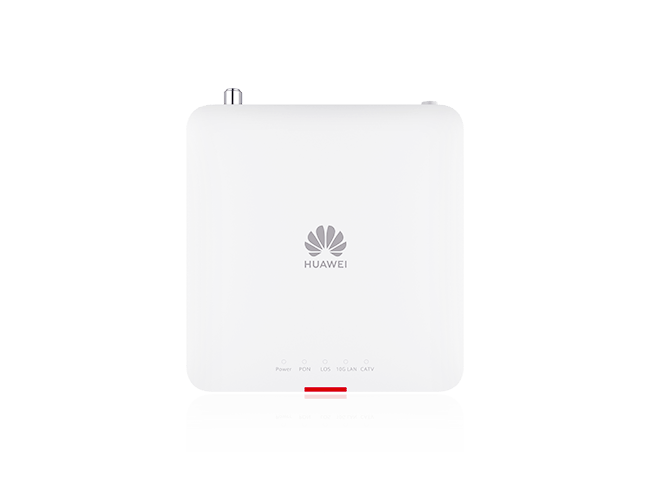
Huawei EN8012Ts-20 XGS-PON ONT terminal 1x 10GE, 1x CATV (RF), SC/APC
Prezzo
97,90 €
120,42 € IVA inclusa
favoriteLista dei desideri
Notice: Products sold strictly to Internet Service Providers (ISPs) only.
Huawei EN8012Ts-20 is a bridge-type ONT customer terminal designed for use in XGS-PON networks. It features an SC/APC optical connector, receive sensitivity of -27 to -29 dBm, and a maximum throughput of 10 Gb/s in accordance with the standard. The ONT is equipped with 1× 10G Ethernet port and additionally with an antenna connector (RF) that supports CATV. It will work perfectly in all networks using CATV and XGS-PON, enabling the delivery of television and high-bandwidth internet to the subscriber. The offered product is a bridge-type terminal without routing support; it has all necessary functions, enables multicast transmission, and supports IGMP and MLD Snooping.
XGS-PON ONT with SC/APC connector
The offered product is a customer ONT terminal intended for use in XGS-PON networks. It features an SC/APC optical connector, and the receive sensitivity is -27 to -29 dBm. The connection throughput, according to the standard, is symmetrically 10 Gb/s for both downloading and uploading data. Transmission is carried out using wavelengths of 1260–1280 nm (upstream) and 1575–1580 nm (downstream).

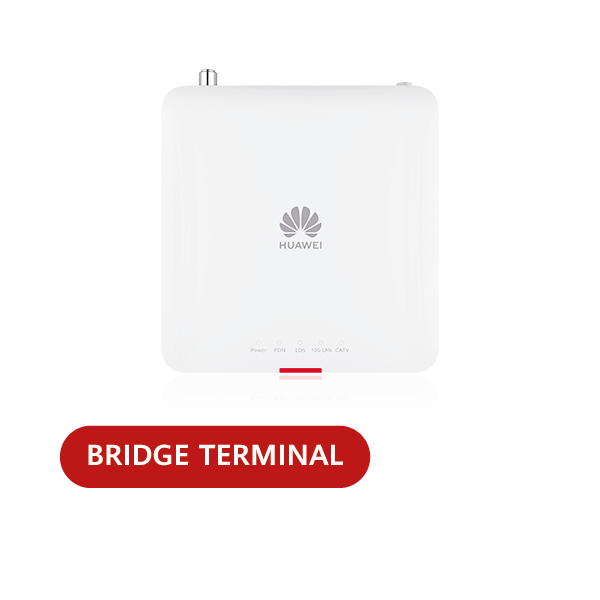
Bridge terminal
The device supports only bridge mode and does not have router functions; it is a standard, single-port ONT from Huawei. Management is possible via OMCI or through the graphical Web interface.
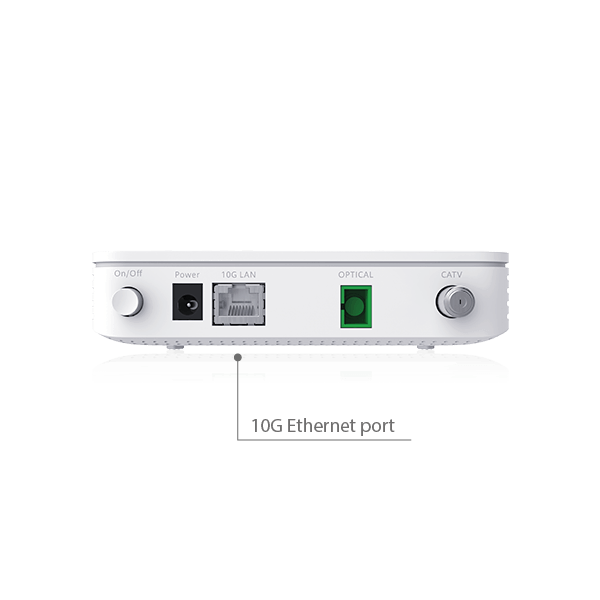
10G Ethernet port
In the ONT, the manufacturer has implemented a 10G Ethernet port, which allows full use of the bandwidth provided by the XGS-PON standard. The port supports automatic speed negotiation and can operate at 100 Mb/s, 1 Gb/s, 2.5 Gb/s, 5 Gb/s, or 10 Gb/s.
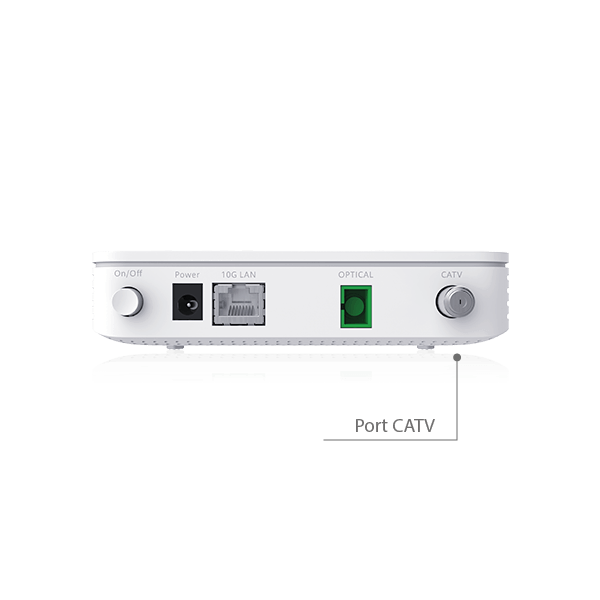
CATV port
An additional and key feature of the EN8012Ts-20 is the RF port, which can be used in CATV networks. This allows delivering television services to the customer without using IPTV.
Specifications
| Huawei EN8012Ts-20 | |
| Device Parameters | |
|---|---|
| Dimensions (H x W x D) (without pads) | 32 mm x 135 mm x 140 mm |
| Weight | About 236 g |
| Operating temperature | 0°C to 40°C |
| Operating humidity | 5% RH to 95% RH (noncondensing) |
| Indicators | Power / PON / LOS / 10G LAN / CATV |
| System power supply | 12 V DC, 1 A |
| Static power consumption | 2.8 W |
| Maximum power consumption |
5.5 W |
| NNI | XGS-PON |
| UNI | 1x 10GE + 1x CATV |
| Optical connector | SC/APC |
| Memory |
128 MB Flash 32 MB RAM |
| Interface Parameters | |
| XGS-PON port |
Class N1/N2/E1 Receiver sensitivity: -27 dBm ~ -29 dBm Wavelengths: 1260-1280 nm upstream, 1575-1580 nm downstream Wavelength blocking filter (WBF) Flexible mapping between GEM Port and TCONT SN/Password/SN+Password/Bi-directional authentication based on OMCI Upstream and downstream FEC SR-DBA and NSR-DBA Upstream and downstream rate: 9.953 Gbit/s upstream, 9.953 Gbit/s downstream |
| Ethernet port |
Ethernet port-based VLAN tags and tag removal 1:1 VLAN, N:1 VLAN, or VLAN transparent transmission QinQ VLAN Limit on the number of learned MAC addresses MAC address learning Auto-adaptive 10000Mbit/s, 5000Mbit/s, 2500Mbit/s, 1000Mbit/s, 100Mbit/s |
| CATV port |
Frequency Range 54 MHz to 1000 MHz Output resistance 75 ohms Received average optical power: -8 dBm to +2 dBm RF output power: ≥17dBmV/Ch (With RF source analog channel power input = 20dBmV/ch, and 40 analog / 63 digital channels (4.3% OMI analog, 2.15 % digital)) |
| Product Function | |
| Smart O&M |
Variable-length OMCI messages Rogue ONT detection and isolation from the OLT PPPoE/DHCP simulation testing |
| Multicast |
IGMP v2/v3 snooping MLD v1/v2 snooping Fast leave VLAN tag translation, transparent transmission, and removal for downstream multicast packets IGMP/MLD protocol packet rate limitation |
| QoS |
Ethernet port rate limitation 802.1p priority SP/WRR/SP+WRR Broadcast packet rate limitation Flow mapping based on the VLAN ID, port ID, or/and 802.1p |
| O&M |
OMCI/Web UI Dual-system software backup and rollback 802.1ag Ethernet OAM Optical link measurement and diagnosis |
| Security | MAC address filtering |
Altri clienti hanno acquistati anche questi prodotti:
Altri prodotti che ti possono interessare: