



 Polski
 English
 Italiano
 Español
 Čeština
 Српски
 Deutsch
 Ελληνικά
 Slovenský





-
$

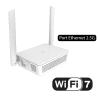
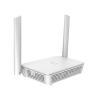
Huawei OptiXstar EG8145B7N-50 EPON/GPON ONT terminal Wi-Fi 7 BE3600, 1x 2.5GE, 3x GE, 1x POTS, 1x USB
Prezzo
58,34 $
71,76 $ IVA inclusa
favoriteLista dei desideri

Notice: Products sold strictly to Internet Service Providers (ISPs) only.
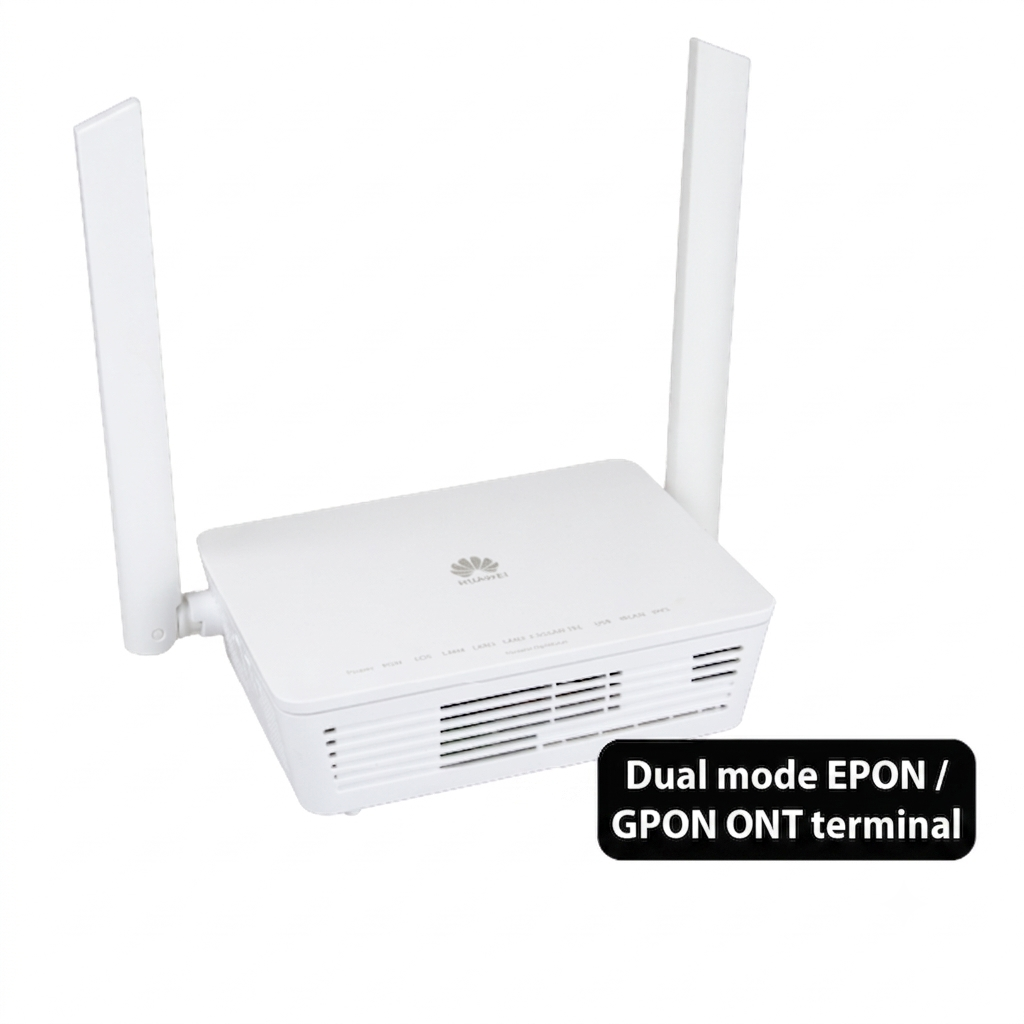
The Huawei OptiXstar EG8145B7N-50 is an ONT customer terminal designed for EPON / GPON networks. Optical transmission is handled by an SC/APC connector with a Class B+ laser, while the receiver sensitivity is -27 dBm. The terminal can broadcast a Wi-Fi 7 wireless network and supports IEEE 802.11 b/g/n/ax/be protocols in the 2.4 GHz band and IEEE 802.11 a/n/ac/ax/be in the 5 GHz band. The maximum theoretical Wi-Fi throughput is 688 Mb/s in the 2.4 GHz band and 2,882 Mb/s in the 5 GHz band. The terminal provides higher wireless performance than standard Wi-Fi 6 solutions with 2x2 MIMO.
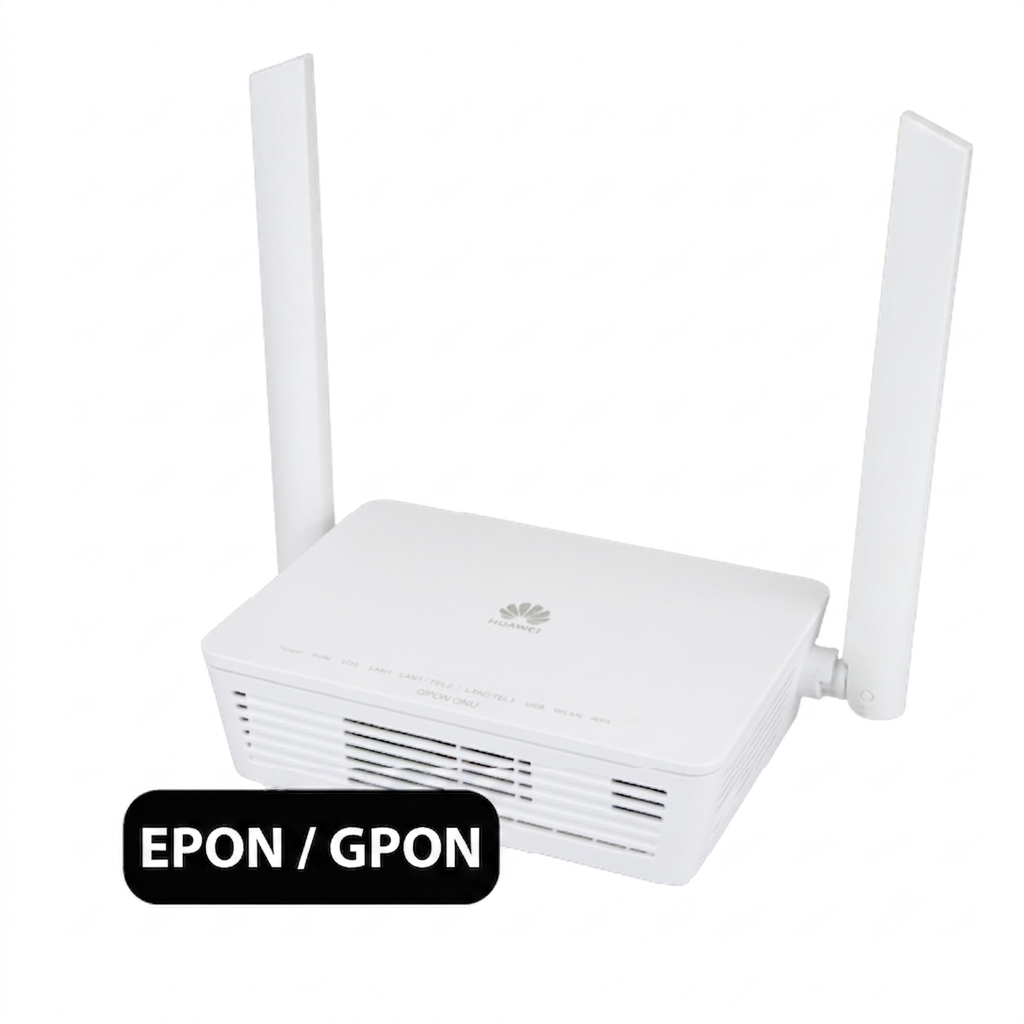
The device is equipped with one 2.5G Ethernet port (10/100/1000/2500 Mb/s) and three 1G Ethernet ports (10/100/1000 Mb/s). The use of a 2.5G port allows full utilization of the bandwidth offered by the GPON standard (2.5 / 1.25 Gb/s). Additionally, the terminal features one POTS port for connecting an analog telephone and a USB 2.0 port. The manufacturer has equipped the device with external omnidirectional antennas with a gain of 5 dBi. They provide better wireless coverage compared to devices with integrated antennas.
Purchase Information
The offered terminal features firmware adapted for operation in EPON and GPON networks with automatic detection of the connected network type.
GPON / EPON ONT Terminal
The offered product is designed to operate as an ONT customer terminal in GPON / EPON networks. It is equipped with an SC/APC optical port featuring a Class B+ laser. The receiver sensitivity is -27 dBm. The device automatically detects the connected network type and selects GPON or EPON mode accordingly.
According to the GPON standard, the transmission throughput is 2.5 Gb/s for downstream and 1.25 Gb/s for upstream. In EPON mode, the transmission throughput is symmetrical at 1.25 Gb/s.
Wi-Fi 7 BE3600
The device can broadcast a Wi-Fi 7 wireless network and supports IEEE 802.11 b/g/n/ax/be protocols in the 2.4 GHz band and IEEE 802.11 a/n/ac/ax/be in the 5 GHz band. The maximum theoretical throughput is 688 Mb/s in the 2.4 GHz band and 2,882 Mb/s in the 5 GHz band. This performance is sufficient for most subscribers and provides a high level of comfort when using Internet resources.The device is compatible with Huawei K562 Mesh, and the configuration process is similar to the EG8145X6-10 model.
In addition to features known from previous generations, Wi-Fi 7 introduces two important technologies — Multi-RU and MLO. Multi-RU allows multiple resource units (RUs) to be assigned to a single user, improving network efficiency. It eliminates situations where a resource unit remains unused because it is not assigned to any client.
MLO (Multi-Link Operation) enables devices to transmit and receive data simultaneously over multiple frequency bands (in this case, 2.4 and 5 GHz). This significantly improves throughput compared to older Wi-Fi 6 / Wi-Fi 6E standards, where a client could only be connected to a single band at a given time.


1x 2.5G Ethernet Port, 3x 1G Ethernet Ports, 1x RJ11 Port, 1x USB Port
One of the key advantages of the EG8145B7N-50 is the use of a 2.5G Ethernet port, which allows you to take full advantage of GPON technology. Without upgrading your network infrastructure to XG-PON / XGS-PON, you can offer subscribers Internet packages with speeds exceeding 1 Gb/s. The remaining three ports support the standard 1 Gb/s throughput.
Additionally, the device is equipped with an RJ11 telephone port (POTS), which is useful if you provide VoIP services. The USB port allows users to, among other things, create a file server or share printers.
Ideal Customer Terminal for GPON / EPON Networks, Automatic Detection
Thanks to its latest-generation Wi-Fi technology and the use of a 2.5G Ethernet port, the EG8145B7N-50 is an ideal customer terminal for your network. It allows you to offer subscribers triple-play services with Internet access speeds exceeding 1 Gb/s. The device supports GPON and EPON technologies, so there is no need to replace your existing network infrastructure to stay ahead of the competition. The EG8145B7N-50 automatically detects the type of connected network without requiring any configuration changes.
Specifications
| Huawei EG8145B7N-50 | |
| Device Parameters | |
|---|---|
| Dimensions (H x W x D) | 40 mm x 150 mm x 108 mm (without external antenna and pads) |
| Weight | About 282 g |
| Operating temperature | 0°C to 40°C |
| Operating humidity | 5% RH to 95% RH (noncondensing) |
| System power supply | 12 V DC, 1,5 A |
| Power adapter input | 100 - 240 V AC, 50/60Hz |
| Memory |
128 MB Flash 256 MB RAM |
| Static power consumption | 5 W |
| Maximum power consumption |
14 W |
| NNI (WAN) | GPON, EPON |
| UNI (LAN) | 1x 2.5GE, 3x GE, 1x POTS, 1x USB, Wi-Fi 7 |
| Optical connector | SC/APC |
| Indicators | Power / PON / LOS / LAN1 / LAN2 / LAN3 / 2.5GLAN / TEL / USB / WLAN / WPS |
| Interface Parameters | |
| GPON port | Class B+ Receiver sensitivity: -27 dBm Overload optical power: -8 dBm Wavelengths: US 1310 nm, DS 1490 nm Wavelength blocking filter (WBF) of G.984.5 Flexible mapping between GEM Port and TCONT GPON: consistent with the SN or password authentication defined in G.984.3 Bi-directional FEC SR-DBA and NSR-DBA |
| WLAN | IEEE 802.11 b/g/n/ax/be (2.4GHz) IEEE 802.11 a/n/ac/ax/be (5GHz) 2×2 MIMO (2.4GHz&5GHz) Antenna gain: 5 dBi Air interface rate: 688 Mbit/s (2.4GHz), 2882 Mbit/s (5GHz) 4096 QAM 160 MHz frequency bandwidth OFDMA MU-MIMO DCM BSS Coloring Beamforming Band steering WPA3 MLO (Multi-Link Operation) Multi-RU WMM/Multiple SSIDs/WPS |
| POTS port | Maximum ringer equivalence number (REN): 4 G.711A/μ, G.729a/b and G.722 encoding/decoding T.30/T.38/G.711 fax mode DTMF Emergency calls (with the SIP protocol) |
| USB port | USB2.0 FTP-based network storage File/Print sharing based on SAMBA DLNA function |
| Ethernet port | 1x2.5GE+3xGE Ethernet port-based VLAN tags and tag removal 1:1 VLAN, N:1 VLAN, or VLAN transparent transmission QinQ VLAN Limit on the number of learned MAC addresses MAC address learning GE port supports auto-adaptive 10 Mbit/s, 100 Mbit/s or 1000 Mbit/s 2.5GE port supports auto-adaptive 10 Mbit/s, 100 Mbit/s, 1000 Mbit/s or 2500 Mbit/s |
| Product Function | |
| Smart interconnection | Smart Wi-Fi coverage SIP/H.248 auto-negotiation Any port any service Parental control |
| Smart service | Scheduled Wi-Fi shutdown Smart Wi-Fi sharing: Portal/802.1x authentication; SoftGRE-based sharing |
| Smart O&M | IPTV video quality diagnosis Rogue ONT detection and isolation from the OLT Call emulation, and circuit test and loop-line test PPPoE/DHCP simulation testing Neighboring AP scanning |
| Layer 3 features | PPPoE/Static IP/DHCP NAT/NAPT Port forwarding ALG, UPnP DDNS/DNS server/DNS client IPv6/IPv4 dual stack, DS-Lite and IPv6 SPI Static/Default routes Multiple services on one WAN port |
| Multicast | IGMP v2/v3 snooping IGMP v2/v3 proxy MLD v1/v2 snooping |
| Security | SPI firewall Filtering based on MAC/IP/URL addresses Secure boot |
| Q&M | OMCI/Web UI/TR069 Variable-length OMCI messages Dual-system software backup and rollback |
| QoS | Ethernet port rate limitation 802.1p priority SP/WRR/SP+WRR Broadcast packet rate limitation |
| Home network feature | Visualized home network management User-defined bandwidth allocation Wi-Fi optimization & Wi-Fi roaming Wi-Fi O&M |
Altri clienti hanno acquistati anche questi prodotti:
Altri prodotti che ti possono interessare: